Brother and Sister Polio Victims Get Wheelchairs
Posted on | December 13, 2009
Help Times Two
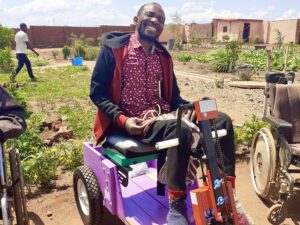
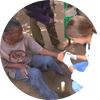
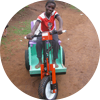
Dedza, Malawi … Dosidedi Filiberito is the younger brother of Donesiya Filiberito of Nkutu Village, Traditional Authority Kamenya Gwaza in Dedza District. Dosidedi is about 30 years old while the sister, Donesiya is about 35 years old. Both were victims of polio within two years of birth, and have never walked during their entire lives.
Upon receiving the wheel chair, Donesiya, the girl said, “thank God I can now go to church.” She said that although the church is only about 200 meters from her house no one was willing to carry her to church week after week after week. Now that she has a wheel chair she will be able to go to church.
Dosidedi, on the other hand said that he has been craving to go and see the new trading centre two kilometers away, but no one was willing to carry him there. He is therefore looking forward to wheeling himself to the trading centre for the first time in his life.
Both Dosidedi and Donesiya thanked the Malawi Project, and their contributors, for the donation of the wheel chairs.
Augustine Bobo,
Dzidalire Community Development Agency
Dedza, Malawi

Note: While the dreaded scourge of polio has been nearly wiped out in the west, it is still a major problem in sub-Sahara Africa. There are countless stories like this one where children and adults are helpless to get around as a result of polio.
6 Year Old Mosquito Victim
Posted on | December 6, 2009
Mosquito Confines Her to Silence and Wheelchair
Unknown Village, Southern Malawi … The African sun was beating down at nearly 100 degrees. Sweat beads slowly roll from my hat to my eyebrow where I periodically wipe them away. We turn south from the tarmac road and almost immediately it turns into a curving, pot-filled, rock cluttered obstacle course. It is obvious the “road” is more fitted to foot traffic or an ox cart at most. The land here is rolling with steep hills and cliffs dotting the area like pimples on a teen-ager’s face. After turning the wrong direction two or three times, as there are no road signs in this part of the world and few people can give you directions any farther than 15 or 20 kilometers, we pull up at the foot of a steep hill with a sharply sloping incline beckoning us to try our mountain climbing skills.
I am traveling with Wilson Tembo, from the Namikango Hospital in southern Malawi, and we are on the way to report a story of a little girl who had recently been given a wheelchair by the Clinic after receiving wheelchairs from the Malawi Project and the Free Wheelchair Mission. I considered the fact that we may have discovered the end of the earth, but then I mentally remembered I had flown over this area coming up from Johannesburg two days earlier. I guess there really is a land beyond this remote area.
How Can Anyone Move Along This Path?
Thank goodness we don’t have to go very far up the mountain. We carefully pick our way up the lower slope as I mentally wonder how anyone can carry even a small child farther up this rock maize path. And soon the rains will come. How would they ever make any kind of trip up or down this path during the rains? And the rains go on for 4 months in this part of the world.
In the distance an unseen baby cries in a remote hut. The answer comes from the other side of the road, as a goat looks in the direction of the hut and bleats out some sort of response. As we reach the house the family has gathered near a bamboo mat under a group of mango trees. Wilson and I lean down to keep from hitting our heads on the low hanging mangos, and move to the edge of the mat. It is there for us along with a small stool to sit on that had been brought out for me. The family sits on the ground and has little Judith Qatungwe with them.
Cerebral Malaria is Fatal 50 Per Cent of the Time
Judith is 6 years old, and she could walk, talk and get around on her own when she was 3. Then suddenly, and with little warning, a small mosquito bite proved nearly fatal. The mosquito was a carrier for the deadly strain of malaria called Falciparum, and it can be fatal in as many of 50% of all cases. She felt victim to cerebral malaria. Young Judith was in a coma for a full week and when she seemed well, the family realized she could not walk, talk or even control many of her movements. Now she had to stay at home with her father while her mother worked in a distant school to which she walked each day. While caring for Judith the father could not go into the fields. Since he is a farmer, to stay in the house too long, would put the future food supply for the family in jeopardy. There was nothing the family could do, when her brothers and sisters went to school, except leave Judith at home alone while they worked. Neither her mother nor her father could carry her with them every day.
Read more
Tags: malaria > Namikango > wheelchair > Wheelchairs
Strange thing – November Maize
Posted on | November 29, 2009
So Strange in November
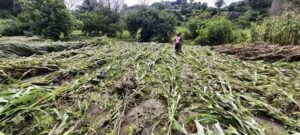
Thondwe, Malawi … There is nothing unusual with seeing a field of ripened corn this time of year, since October and November are the harvest time in the mid-western part of the United States. The fact that makes it so unusual is this scene is not in the United States, it is in sub-Sahara Africa and most farmers here are just getting ready to plant their maize (corn), not harvest it. In fact it has not rained here in 5 months and the seasons in this part of Africa are exactly opposite those of the U.S. The U.S. in the northern hemisphere plants in April and May and harvests in October and November. Here in southern Malawi, farmers plant in December and harvest in April and May. The only rains in this part of Africa come in this time frame. The rest of the year there is no rain at all.
Now the scene of ripened corn is a strange one at this time of year. How can it be? How can one farm have ripe maize at one end of the field and at the other end have the field fully cultivated and ready to plant when the rains start in a couple of weeks? One thing makes it possible. That one thing is the V-Tractor and the large tanks of water that rest underneath the frame in order to pick up water at the nearby river and spray it across the fields to create the needed moisture for a second crop on the same land, a crop that grows where there is no rain. It can change the landscape of farming in sub-Sahara Africa and beyond. It is the V-Tractor and it is as strange looking as a field of maize in the middle of the dry season.
This scene is at the Namikango Mission and Clinic in Thondwe, Malawi, and is made possible by the V-tractor, and by contributions from L.T. Rich Manufacturing and the Agricultural Aid International of Lebanon, Indiana and the Malawi Project.
Wheelchairs Await Their New Owners
Posted on | November 22, 2009
Wheelchairs Seemed to Arrive Early
Kasungu, Malawi … From all appearances the wheelchairs were up early and reached the site of the ceremony well ahead of the crowd. Of course, one has to realize that many in the crowd were slow getting around since nearly all of them live with severe handicaps that make rapid progress slow or impossible.
George Banda, the Director of KODO had the wheelchairs assembled and ready when the 25 students and 5 older people with walking handicaps arrived at the school near Kasungu in the northern part of the central region of Malawi.
Chankhanga Primary School, in the Kasungu District of Malawi, offers education to children with special needs. A spokesperson for the school reported, "Our children will now be able to attend classes daily which was not the case before because of mobility problems. Most of the time these children were absent from classes. Thank you to KODO for giving us these wheelchairs.”
According to George Banda, “The ceremony was carried out on an area of open ground and witnessed by many who came to see what the Malawi Project has done to enable KODO to reach this far in helping these people. Thanks.”
“As is the case with everything that is done to help the people of Malawi there are numbers of people behind the scenes who make it all possible,” reports Richard Stephens of the Malawi Project. “Free Wheelchair Mission, KODO, the Malawi Project, and a multitude of contributors make it all possible, but most are never seen. To so many people in Malawi they will never hear the names of their many benefactors, nor will they ever see them. They only know they are now in school, and they can make a different life for themselves because someone, someplace heard the call from Jesus to help those who are poor and suffering.”

Site Inspection Proves Pleasant
Posted on | November 15, 2009
Site Inspection Proves Pleasant
Thondwe, Malawi … Reaching Malawi on Thursday late afternoon board members Dick and Suzi Stephens were taken to the Namikango Mission and Maternity Clinic for the evening. Reports on the progress of the Mission were reflective of so many ministries that rely on western funds in order to carry out their work in third world nations. Funds are down, programs are slowing, and aid to so many of the worlds poorest people is taking a major toll on those who can go no lower on the economic ladder before a sickening crash at the bottom. Mark Thiesen reports, “The trip we just returned from to the states gave little results. The recession is hitting us harder than most. We are cutting back as far as we can go.”
The same is seen in the shipments reaching Malawi from the Malawi Project. The slower pace of funds, supplies, and equipment hast taken a drastic downturn as the recession cuts deeply into the aid being sent.
In spite of the problems one of the bright spots can be seen in the efficient way Wilson Tembo, the Warehouse Manager at the building on the Namikango Mission site is handling the warehousing and distribution. The site, located in Thondwe, Malawi, about 40 minutes east of the commercial center of Blantyre serves as a drop site for supplies to the southern region of Malawi. An early morning inspection of the facilities indicates a high degree of efficiency and professionalism in the way the supplies are being handled, inventoried, and distributed.
Sandida Boko
Posted on | November 8, 2009
Who Can Carry and 18 Year Old?
Dedza District, Malawi … The question poses all kinds of thought and response:
“I might for a few feet.”
“I might if she were not too heavy.”
“I might if the ground were level.”
The problem comes when one realizes these conditions cannot be met.
Sandida needs to be able to go far greater distances than just a few feet. She is now too heavy for her aged mother to carry, and the ground is seldom level enough for anyone to carry a heavy load very far without falling. Yet, it has been the plight of Sandida’s mother and family for weeks, months and in fact, for years.
Sandida Boko is 18 years old, and comes from Nkutu village, Traditional Authority Kamenyagwaza in Dedza District, Malawi. She was a normal child until 1999 when she was attacked by epilepsy. It resulted in periodic impairment of consciousness, and this was accompanied by convulsions. Overtime, she lost her ability to walk. She was relying on her mother (the lady in a blue and gold shawl with one side of her face swollen in the picture) and her young sisters and brother to move around.
In a nation where the average person walks 10-miles a day it is nearly impossible to get around if you cannot walk. There are no sidewalks anywhere in the Dedza district. There are almost no paved roads, outside of M-1 and one road that goes over toward the lake well south of the Trading Center. And there is no way to get around in the village, seldom even a bicycle that can supply transportation to a crippled 18-year-old.
No wonder the gift from the Free Wheelchair Mission to the Malawi Project and on to the Dzidalire Community Development Agency for delivery to Sandida and her family was such a fantastic gift to the entire family.
When Sandida’s mother received the wheelchair from the Dzidalire Community Development Agency she was very excited and full of praise of the Malawi Project which donated the wheelchairs. She said, “Sandida was getting too heavy for her and her other children to carry around. Sandida will from now on be able to move around on her own. She will be able to go out and mix or play with her friends on her own. May God bless the donors of the wheelchair.”
The V-Tractor Update
Posted on | November 1, 2009
The V-Tractor is Hard at Work
Like many parts of Malawi, the area around Thondwe (in the southern part of the nation) is extremely rich with natural resources. Trees, hills, animals, water, and much more are all naturally a part of daily life for the people around Thondwe and the Namikango Mission and Maternity Hospital. The possession of the V-Tractor has added another water resource use. Bordering the Mission to the north is the Naiwale River. It serves as the line of demarcation between the Mission and the villages to the north. The river meanderers inside the Mission’s forests and has a long life due to the shady cover over it. Out in the open areas it losses much of its water through evaporation. Here in the shade of the forests it provides the precious commodity to surrounding community for domestic purposes.
In addition to providing water for domestic purposes the river is also a source of water for Mission’s irrigation plot. With its large water tank attached, the V-tractor is able to pump enough water into its tank and irrigate the land in far less time than people could manually do on the same distance and time. Lying approximately one kilometer from the river, the irrigation plot serves as a demonstration plot for high yield maize varieties to the community around the Mission.
The V-tractor, a brain child of Americans Tom Rich and Richard Stephens, is proving its full effectiveness in cost and time reduction, while at the same time increasing the results of its labor in the fields. So far, it has proved effective in tilling and irrigating the field with great ease. In line with the Malawi government’s top most priority area of focus, which is increasing Agricultural production, the tractor is expected to improve yield production directly or indirectly. Indirectly because, with the winter cropping conducted at the Mission, many people will learn how to cultivate, and to plant high yield maize varieties that will go a long way in adding food production to the country.
The pictures are not for show. It is a V-tractor at hard at work on a sunny Wednesday morning with the machine going about its normal duty. Pedestrians, cyclists, and motorists all paid a great deal of attention because, to many of them, this was the first time to see such a tractor. A farmer at a nearby garden from where water for irrigation was being pumped asked where could access such a tractor. He was totally surprised with such a machine, when he learned it could be used for both tilling and irrigating the field.
- Wilson Isaac Tembo
Wheelchair Mobility
Posted on | October 23, 2009
WHEELCHAIR MOBILITY TO ENELESI WEBU
It has been said, “Disability is not inability.” I am sure this is a very motivating statement that disabled people are excited to hear. However, think of the other side of this thought. Think of a young girl in a very remote village of the southern part of a small country like Malawi who has both legs and hands paralyzed. Who can foresee any ability in such a child to attend classes without support? What ability can come out of such a child if she is not given a hand in the absence of both parents, while old grandparents are raising her while at the same time they themselves depend on people’s handouts.
If you were to go through the small hut village of Majawa west of Namikango Mission, in traditional Authority Mulumbe-Malawi, you would find young Enelesi, sitting on the ground in the sun. This is not by her desire. It is because her disability has brought inability.
Enelesi was born in the family of Mr. & Mrs. Webu 22 years ago. She was healthy, charming, and intelligent. Like most children she enjoyed life with her father and mother for the seven years. Then her father divorced her mother. Enelesi started school, but unexpectedly and unpredictably both of her legs were paralyzed. Shortly after both of her hands followed suit. As if that was not enough, both parents passed away starting with her father in the year 1994 and her mother in October, 2008. This left her with only her grandparents Mr. and Mrs. Pirato. The old fellow could not manage carrying young Enelesi to school after all of the efforts to treat her proved futile.
When the news of Enelesi’s suffering reached Namikango Mission I paid a surprise visit to her one Tuesday afternoon and brought mobility means, a new wheelchair that had only recently arrived at the mission.
Like water under a growing plant reaching out to put down roots, aid from the Malawi Project is reaching to the furthest tip of communities where the actual need is. To Enelesi, disability had proved to be inability. She could not attend classes, no church services, no socializing with friends; she was slowly and surely becoming idle each passing day. Perhaps for some disability means inability, it is untrue in this case. Now Enelesi can attend classes, church services and many other activities.
With a broad smile that reveals the excitement inside her, Enelesi shows how happy she is when I moved her around her home yard in the new wheelchair. “The only thing that Enelesi has been able to do when she needs something is to cry out. She cannot speak now,” her grandmother told me. She further said, “Now Enelesi will be going to Church where in the past, some of the members from her church had to come here for prayers on Sundays.” Enelesi’s grandmother ran out of words as she witnessed Enelesi’s spiritual life opening up again. It is written, “Helping to change the Nation” and “Serving the World” in the Mission Statements of the Malawi Project and the Free Wheelchair Mission. This can be witnessed in a small country of Malawi with Enelesi Webu.
WILSON ISAAC TEMBO
For: Namikango Mission

![]() |
![]() |
![]() |
Death Cheat
Posted on | October 16, 2009

Cheats Death
Going Outside After 22 Years
Ntcheu, Malawi … It made national news in one of the leading newspapers in the tiny African nation of Malawi. The front-page headline seemed to scream for attention, “Death Cheat – Bed Ridden for 22 years.” Farther inside a nearly full page leads off with the headline, “Ntcheu lady sees light after 22 years.” What is it that calls for such bold headlines, and such a touching story of hope and success? The story finds its origin in a working relationship between the Malawi Project, the Free Wheelchair Mission, and in this case, the Kuthandiza Osayenda Disability Outreach (KODO) operations in Salima, Malawi.
The story began when a recent shipment of 550 all terrain wheelchairs were shipped to Malawi, thanks to supporters with the Free Wheelchair Mission and the Malawi Project. A portion of this shipment was earmarked for distribution through (KODO) in Salima, a support facility for the disabled that is helping bring various forms of mobility and independence to people who cannot get a start for themselves.
Meanwhile in a village area far to the south of Salima in the Ntcheu District lived a woman who had been bed ridden for 22 years because of her disability and the fact that there was no one to take her outdoors. Twenty-two years locked in the invisible prison walls of a single, tiny bedroom. Twenty-two years of never seeing friends walking within just feet of the outside of your tiny hut. Twenty-two years of never watching a sunrise or sunset, or even breathing in the fresh air that drifted so very near to her confined dark hut.
George Banda, the administrator of KODO writes, “In spite of her own disability Dorothy traveled 400 kilometers in order to pick up a wheelchair when they arrived in Salima, and return with it to the small village.”
Now it is possible for her to greet friends as they pass the front door, sunrise and sunset have returned to being part of her life, and she can now see and feel the gentle breezes that wisp past her hut,. All of this is now reality because a number of people combined their resources to bring mobility into her life.
One can no longer wonder why the newspaper headlines seemed to scream out such a wonderful, inspiring success story.

At First it Looked Like Rubbish
Posted on | October 10, 2009

Help Needed to Build Safe Kitchen
At First It Looked Like Rubbish
Thondwe, Malawi… From a distance it almost looks like a pile of metal stacked up near a clearing waiting to be thrown away. But as one walks along the path near the Namikango Maternity Clinic, and reaches a point near the rusted metal panels, it is obvious that it is something more than a pile of rubbish. It is actually a kitchen for the guardians of hospital patients to use for cooking meals for their relatives who are patients in the hospital. Because of so many more critical needs for the funding that is always in short supply (and especially so during this economic downturn) the “kitchen” is in last place when it comes to repair. In order to assist with the funds to construct a new kitchen the Malawi Project is giving this report. It is important to realize how little it will take to help the people who spend days at the clinic caring for relatives who cannot care for themselves. Mark Thiesen, the American administrator at the Mission writes,
“One courtesy offered by Namikango Maternity Clinic, that we often fail to mention, is the accommodation we provide for family members of patients. Like our other services, room and board is free for people who come to take care of their mothers, wives, and daughters during their stay in the clinic. They look after their loved ones’ needs during this period. One of the most important of these needs is cooking their meals for them.”
Mark continues, “As our facilities continue to age, the kitchen used for this purpose has deteriorated to such a degree that its very stability is now threatened. The structure’s supporting beams have decayed to such a point that the kitchen presents a real danger to the family members who have come to help our patients. The kitchen must be rebuilt if we are to provide a safe decent environment for our visitors. At a cost of $3,614.00 we can totally rebuild it to continue serving the people of our community with confidence.”
See More Photos: Click HERE
Or Mail Contributions can also be mailed to:
Malawi Project – Namikango Kitchen Fund
12526 Clearview Lane
Indianapolis, IN 46236