Chief Mdelakwanda Speaks About His Villages

MalawiCulture, Economy of Malawi, People of Malawi, Nation of Malawi, About Malawi

The Lake Spreads Out in Front of Him

    Wind whipped trees turn their faces toward the land and away from the winter winds that push angry waves in from the lake. Dark, broken clouds force the sun to climb unseen into an angry sky, while a lone seagull tries unsuccessfully to skim along the wave tossed surface.

    Along the beach a row of weather beaten fishing boats lay at attention as a lone light burns atop an unkempt ragged looking building. Minutes pass and the early dawn begins to lighten with a tinge of pink as the unrelenting sun seeks a peek hole through which it can influence the day. Dark shadows move among the silent boats as the fishermen of the ancient village prepare to challenge the white caps that tear away at the sandy beach on which the boats lay uneasily. Some of the fishermen challenge the lake in long boats, motorized with modern outboard engines, while others drag carved out logs into the pounding surf.

Mdelakwanda Has Witnessed This Scene
    It is a scene that Chief Mdelakwanda has witnessed a thousand times, and although he is not on the beach he knows the picture full well. More minutes tick away and the activity intensifies from the village. As the sun tries to make its presence known the people awaken to the urgency of getting the boats away. The lone seagull returns for another challenge, then unsuccessful, he gives up and floats defeated in over the trees.

    From somewhere a lone figure appears on the beach, passes the long boats without a word, and then disappears into the distance near the village as though he has someplace to go. Still more minutes pass and the sun begins to take control of the sky and push the menacing clouds off to the west. Women come to the shore to wash mismatched pans and silverware, while the wind persists and the waves maintain control of the shore. The fishermen seem not to notice as they continue to prepare. Finally the boats are ready and the struggle begins against the persistent surf and the unrelenting waves. Life seems so fragile, so frail, and unsure. The waves seem so strong, so definite, so threatening. Two hours pass with great effort and agonizing progress.  Finally the last of the long boats are away. Away from the danger of the shoreline too, are the carved out logs that are manned by a single fisherman. They paddle hard to position themselves where they can be picked up by the long boats out they wait beyond the breakers. With each turbulent surge from the waves the log boats disappear into the trough, and then pop up again as the water rises again to form the next wave.

    Finally the last of the fishermen have disappeared over the horizon and the village waits for their return at the end of the day. As morning slides into afternoon the wind seems to lesson and the surface of the lake slackens its onslaught on the shore and eyes turn toward the east to see the fishermen return.

The Chief Looks Away From The Sun
    On the shore just south of one of the seven villages that make up his protectorate Chief Mdelakwanda watches for the return of the fishing boats. The sun is heading down in the west and not all of the long boats have yet returned from the fishing grounds east of the villages. Not only is the chief concerned with the size of the catch; he is also concerned that the fishermen come home safely.

    Mdelakwanda is the chief over nearly 13,000 people in the villages of Senga Bay, Malawi. When asked about his age he smilingly says he is 48, while others who know him seem to think he is nearer to 68. "Gardening and fishing," he responds when asked through the translator concerning the means by which his people make a living. Then he turns serious when he is asked what are the greatest problems and needs he faces while trying to care for such a large number of people. He looks over toward Samatha Ludick from the Cool Runnings Lake Resort as through she will answer his question. She smiles and he turns back to the translator. "Medicine, a hospital, and education," he answers with little more hesitation. "Without these things my people will continue to suffer. It is 29 kilometers to the nearest hospital and we do not have single Galimoto (car) among all of our people. No one who is sick can walk that far. We need a place here in Senga Bay where they can go for help."

    "We are also in need of education," he reports to the translator. "Without education our people will always remain doing the same things. We must have a school for our people."

    The chief know he does not have the resources to pull his villages out of the cycle of poverty they find themselves enmeshed; yet he is too proud to ask directly for outside aid.

    Good chiefs in Africa live among their people and use the resources that are made available to them to serve the people with whom they live. Caring for their people is an all-encompassing responsibility and Chief Mdelakwanda takes the job seriously. He looks out across the empty expanse of water then back at the translator.

Mdelakwanda Gives Jurisdiction to Avoid Conflict
    It is a well-known fact that when he was made a chief that his brother, who was not chosen, was angry and upset. Rather than have a continuing family crisis Mdelakwanda gave his brother jurisdiction over one of the village areas. This ended the dispute and both men were content with the arrangement that Mdelakwanda had worked out. Concerning the environment the Chief is a pragmatic man. His concern has little to do with smog in Los Angeles or the melting glacier ice cap at the North Pole. It has everything to do with the equation that concludes, "A dirty environment is bad for heath, and bad heath converts to long and costly time away from the village and in the hospital, and this is a cost he does not wish to share." He like many of the people in this part of Africa, know the top lid of a peanut butter jar when left on the ground and partially full of stagnant water can breed a thousand mosquito larvae. From this can hatch at least 500 mosquitoes. If even a small number of these mosquitoes carry malaria it means more illness. More illness means more cost to the village. He is a pragmatic man. He realizes fewer mosquitoes mean less malaria, less malaria, means less illness, and less illness means a lower cost to the village. It is a pragmatic reason for the Chief to work with Ludick to protect the environment of the Senga Bay area.

    One of the programs Ludick and the chief are successfully accomplishing is the program to harvest the plastic bags and containers that are left behind by the careless, sell them for a profit, and create a cleaner environment that will convert to healthier villagers, lower heath care costs, and a greater measure of tourist interest to his area. It is a plan no chief would want to ignore.

A Yao Chief Waits for His Fishermen to Return
    Mdelakwanda takes his job seriously. A Yao chief his tribal leader is not too far away in the south of Malawi and they all come from a proud and rich heritage. The interview nears its conclusion. The fishing boats are returning to the safety of the village. Chief Mdelakwanda is yet to learn of the success of the day’s catch far out into the lake. It is the 3rd largest lake in Africa and the 12th largest in the world. It can sometimes be a place of great danger. Chief Mdelakwanda knows this full well. He is the chief for seven of the villages that line the shore.

Wheelchairs Stand at Attention

Malawi Healthcare, Wheelchairs, Medical, Medical Shipments & Distribution

     Indianapolis, Indiana … As the Director for the Malawi Project prepares to take the picture Richard Stephens sights into the camera lens and notes how it appeares "the wheelchairs look like they are standing at attention." He and the Medical Director for the Malawi Project, Suzi Stephens are making an appraisal of supplies that will soon be making their way to the Kachere Orthopedic Rehabilitation Hospital in Blantyre, Malawi. Among the supplies that will fill a 40-foot semi trailer are a large number of wheelchairs that are sorely needed in Malawi, the third poorest nation on earth.

    Stephens notes, "This shipment will be the second shipment to Kachere in the past three months. The orthopedic hospital is in turn are making some of the supplies available to Queen Elizabeth Hospital, the largest in the southern region of Malawi, the Bangwe Weaving Factory, a companion facility that is assisting the handicapped and also in Blantyre, and the Naminkango Maternity Hospital in Thondwe, a small trading center just east of the commercial center of Blantyre." Stephens concludes, "We are pleased with the new relationship that is developing between the Malawi Project and the medical facilities in the area around Blantyre. It is fitting very well into our plans that are designed to expand aid throughout the nation of Malawi. We owe a note of appreciation to Mama Cecelia Kadzamira who has helped to bring these contacts into a working relationship to the benefit of the people of Malawi."

Timothy Was Not Just Another Statistic

About the Malawi Project

     Large numbers and statistics harden us.  Daily the media bombards us with facts and figures about suffering in the world.  Maybe because all of this information is so abstract we too easily forget that it represents real people who have the same feelings that we do.  The staggering numbers of Africans being cut down in their prime by tuberculosis, malaria, HIV/AIDS, and other diseases barely register a blip on our radar screen, a single column on page 5, pushed to the side by that big half-page car advertisement, because we just can’t grasp what these people are living through.  Lack of identification brings numbness, indifference.  Yawn.  Let’s turn over to the Sports section instead and see how the big game went last night.

    For those of us who live in Africa the suffering takes on real faces with real histories.  It’s impossible to be indifferent if it’s your friend or loved one who’s wasting away from some incurable illness whose terminal end is inevitable.  You can’t dismiss it from your mind by a flip of the remote.  It’s all around you, touching every person you interact with in one way or another.  Sometimes it destroys those closest to you like my best childhood friend Timothy.

    Timothy and I grew up together since our dads worked with one another on the same church mission.  Two years younger than I, Timothy made the perfect friend.  He experienced with me the games that African kids play like rolling old car tires down the narrow village paths and making toy bulls from local clay mounds.  He taught me how to make the local food called sima in the Tumbuka language, a thick mush made from corn flour.  My first experience cooking was with him as we boiled the sima and fried potatoes over an open fire in our yard.  The good times spent with this loyal friend formed the kind of memories that bring joy to look back upon 30 years later and at the same time inspired hope in us as we looked to the future then.  Timothy wanted to be a bus driver when he grew up, manoeuvring one of the big buses that we used to admire over the rutted muddy roads of our valley.  He would simulate the bass roar of their diesel engines and demonstrate how the driver switched gears. 

    Later when I moved away from Malawi Timothy and I kept in touch by letters.  Two decades passed before I would once again return to live.  Seeing Timothy again after all these years was a priority.  What would he be like as an adult?  Pictures of him indicated he was tall like his father, well over 6 feet, a height rare in Malawi.  Upon our arrival in Malawi it wasn’t possible go to Timothy’s area immediately.  He lived 400 miles away.  And before my family could make this trip the disturbing news came to me that Timothy was off work suffering from tuberculosis and had been for some time.  Friends assured me that he was getting the necessary treatment and was "improving to better."  Discharged from the hospital, he could now receive guests at home.  One day he surprised me by borrowing a friend’s cell phone and calling me.  His deep voice, no longer recognizable as that of the little boy I had known, further encouraged me by its exuberance.  As we made plans for the trip to his area we included a stop at Timothy’s house for the anticipated reunion with my friend.  But this was not to be.  Five minutes from his house the road was barricaded.  Some type of road work was going on up ahead.  We would have to wait three more months until our next trip to see him.  Three more months!  Well, I’d waited more than 20 years.  Timothy was getting better now, so we could wait and possibly find him back to normal when we met again.

    Within a month Timothy was dead.   The TB had had not responded to the drugs.  There had been ups and downs as his body fought the disease, but later I learned that he had been in this struggle for over two years until the TB caught the upper hand and claimed another victim. 

    Another number.  Another statistic.  Another fact for publication.  But for me and all those who shared all or part of their life with this son, brother, friend his death represents the annihilation of any illusions that we might have had about this world, an affront to dreams, hopes, and love everywhere. 

    I wonder what it would have been like to meet my friend as an adult.  What would he have done with his life had it not been cut short by this dreadful disease?  In his maturity had his passion to drive a bus been replaced by other goals and dreams?  Did he plan to marry and have a family?   Cut down in his prime, he never achieved his dreams, whatever they might have become in the years since we had last met.  Instead he left behind grieving loved ones who will always wonder what might have been.  His mother said she felt comforted whenever she sees me because it reminds her of the old days of his childhood when her boy was young and healthy, hopeful and happy.  Memories are all that she has to hold onto now.

    Timothy’s story is just one among millions across a continent ravaged by TB, malaria, HIV, and a host of other diseases.  None of the other stories can be reduced to a cold statistic any more than his can.  There is no way to convert such pain and devastation to figures.  Only God can understand.

By Mark Thiesen

Thwonde, Malawi

Don’t Let Me Starve ~ Teach Me To Fish

Conservation, Agricultural Assistance, Be The Change
Don’t Just Give Me the Fish, for When You Leave I Will Starve to Death. But Teach Me To Fish and When You Leave I Will Continue To Eat.

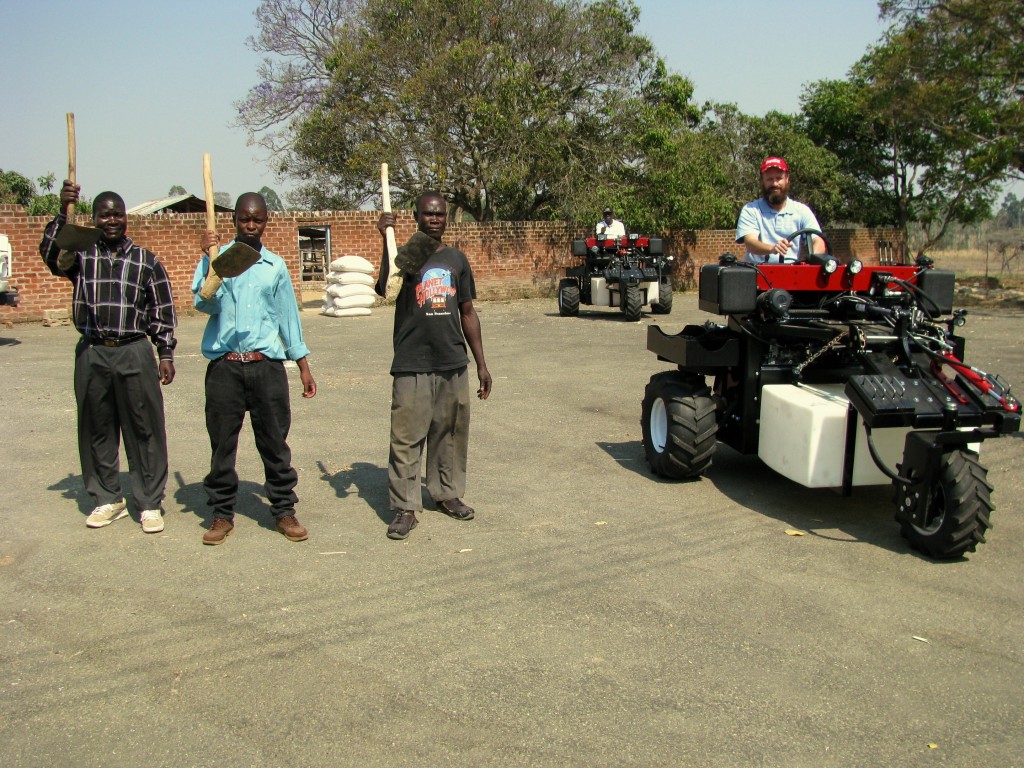
    Lebanon, Indiana … A big smile can be seen on the face of Ari Tello, an employee of L. T. Rich Manufacturing Company in Lebanon, Indiana, as she demonstrates one of the two new V-Tractor prototypes that are ready to go to Malawi in the next 40-foot trailer currently being prepared for shipment.

    The V-Tractor is a concept piece of equipment to aid in agriculture for villages and plot style farming for developing countries. Developed by L.T. Rich Products of Lebanon, Indiana with the help of Richard Stephens of the Malawi Project, the tractor utilizes simplicity and reliability.

    Powered by a Hatz diesel, the tractor utilizes a unique three wheel drive hydrostatic transmission utilizing two independent pumps and three wheel motors.

    The tractor also has an 11 gpm auxiliary hydraulic pump to power attachments. The current tractor can power a 30 gpm water pump, 10 kw generator set, and cement mixer. A wide variety of attachments can be developed for additional applications. In field repairs can be made easily with a small tool kit. A simple forward reverse pedal engages the tractor with no gear changes or clutching.

    These tractors have been a number of years in design and creation and they have been prepared especially for village needs on African small plot farms.

SPECIFICATIONS:

    * Engine: 22 hp Hatz twin cylinder air cooled
    * Transmission: Hydro gear BPD 21-16-11 gpm gear
    * Weight: 2052 lbs
    * Width: 72”
    * Length: 91”
    * Ground speed: 6.7 mph forward, 4 mph reverse.
    * Cultivator:
    * 4 row shovel. 30” row centers. 1 to 4” shovels
    * 2 row chisel. 30” row centers.
    * Water System:
    * Water capacity: 70 gallons
    * Pump capacity: 30 gpm (can fill tank from any water source or use as remote pumping system)
    * Planter:
    * Yetter ground drive planter. Two or four row.
    * Generator:
    * 7.5 kw or 10 kw output @ 1800 rpm. 50 htz. Hydraulic drive.

For additional information about this revolutionary creation go to: www.vtractor.com


Below Tom Rich, the inventor of the V-Tractor gives information to Shola Ajiboye of the Indianapolis African Center about the capabilities of this revolutionary tractor,  and the inventor tests its capability in shake down trials before the units are shipped.


Orthopedic Hospital Praises Supply Shipment

Malawi Healthcare, Medical, Medical Shipments & Distribution

Forty Foot Container Arrives at Kachere
    "It is really a help," notes Mrs. Nthewere one of the nurses at the Kachere Rehabilitation Centre near the south side of Blantyre, Malawi "So many of the patients are very needy and the soap, toothpastes and clothes will see them through. In addition the beds we had were in bad need of repair. Some of the patients, especially the quadriplegics (patients who have lost control of both arms and legs) found it hard to change positions.  The coming of the new adjustable beds in this shipment brings a big change to these patients."  Mrs. Nthewere was referring to a recent shipment of medical supplies that reached the handicap facility from the Malawi Project.

    One beneficiary Edwin Matenda, a 23-year-old patient whose arms, trunk, and legs were paralyzed following a fall from height over 2 months ago, also echoed the advantages of the adjustable beds. "I can now ask somebody to adjust it for me so I can be brought to a sitting position.  I can breathe better and eat well when I am sitting.  Life was difficult on the previous bed.  Thanks for the change", Edwin says.

    "I often fed him in lying position because I couldn’t support his weight in sitting while feeding," said her widowed mother who is his guardian at the institution.  ‘This often led to serious choking.  But this bed has changed everything.  He is fed nicely and it’s lively talking to him in a sitting position." said the smiling mother. "For the clothes, at first it was difficult when he soiled a pair of clothes he had before.  He would have only a bed sheet while the only set of clothes were being dried.  Now I can change his clothes comfortably", said the mother. "Being a widow and caring for him full time at the rehabilitation centre life is difficult.  It is not easy to even get the basic needs. ‘Thank God’, soap, toothpaste and the rest of the things that we have received will help us," said the mother.

    According to G. Chimatiro, the Administrator of the center, "Treating patients with so many needs that we cannot meet is always tough. The trailer of supplies that have been donated came at the right time."
   
    Contributors who assisted the Malawi Project in getting the supplies to Malawi made the 40-foot trailer of orthopedic and medical supplies possible. The shipment left the United States in October and arrived in Malawi in late January.